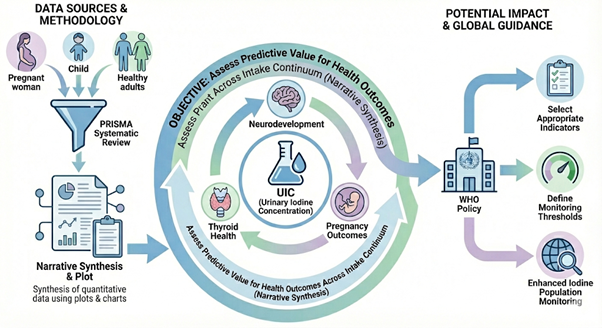

Relationships between urinary iodine and outcomes of iodine status across the intake and status continuum: a systematic review

Funding agency: World Health Organization Objective The objective is to capture and synthesize evidence on the relationships between urinary iodine measures and prioritized health outcomes to better understand iodine status across population subgroups. This includes assessing outcomes among school-age children, pregnant women, and other healthy populations to strengthen guidance on [...]

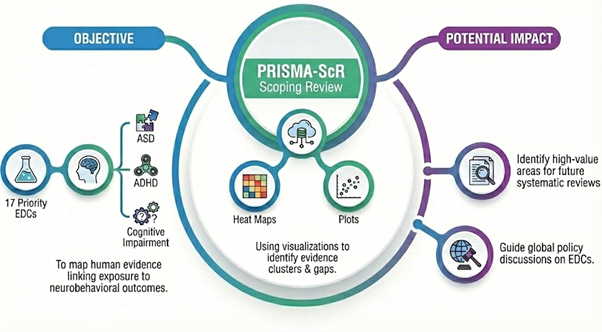
Exploring the Link between Exposure to Endocrine-Disrupting Chemicals and Risk of Neurobehavioral-Related Disorders in Humans: A Scoping Review

Funding agency: World Health Organization Objective The objective is to map and evaluate existing evidence linking human exposure to key classes of endocrine-disrupting chemicals with neurobehavioral disorders across the lifespan. This work aims to identify patterns, inconsistencies, and critical evidence gaps to inform future systematic reviews and policy development. Methodology [...]

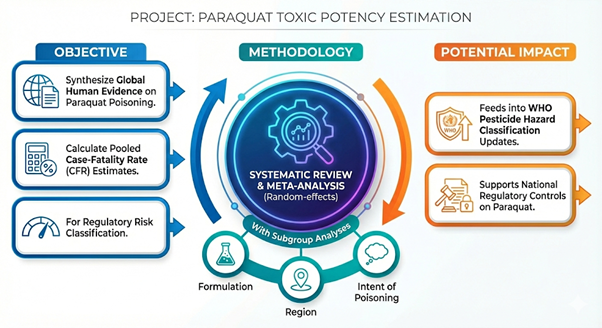
Estimating Toxic Potency of Paraquat in Human Poisoning: A Systematic Review and Meta-Analysis

Funding agency: World Health Organization Objective The objective is to accurately estimate the real-world toxic potency of Paraquat in humans by synthesizing evidence on case fatality rates, clinical severity scores, and other toxicity indicators. The findings aim to refine hazard classifications that currently rely mainly on animal LD₅₀ data. Methodology [...]

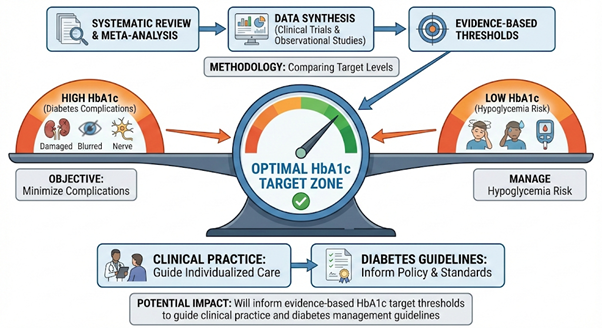
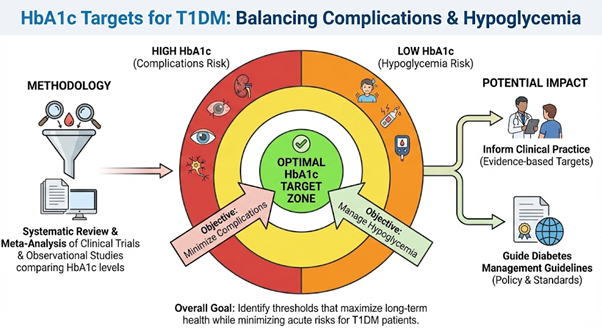
Optimal HbA1c Target value for Minimizing Diabetes Complications Amongst Adult Type 1 Diabetes Mellitus Patients: Systematic Review and Meta-Analysis

Funding agency: World Health Organization Objective The project aims to determine the ideal HbA1c target value required to minimize long-term microvascular and macrovascular complications in adults with Type 1 Diabetes Mellitus. It seeks to identify the threshold that best reduces risks such as diabetic retinopathy, nephropathy, and cardiovascular disease. Methodology [...]

Optimal Frequency of HbA1c Monitoring for Effective Glycaemic Control and Prevention of Complications Amongst Adult Type 1 Diabetes Mellitus Patients: A Systematic Review and Meta-Analysis

Funding agency: World Health Organization) Objective The objective of this project is to rigorously synthesize evidence on how different HbA1c testing frequencies affect glycaemic control and long-term complications in adults with Type 1 Diabetes Mellitus. The review aims to determine the most effective monitoring schedule to support improved clinical outcomes. [...]